

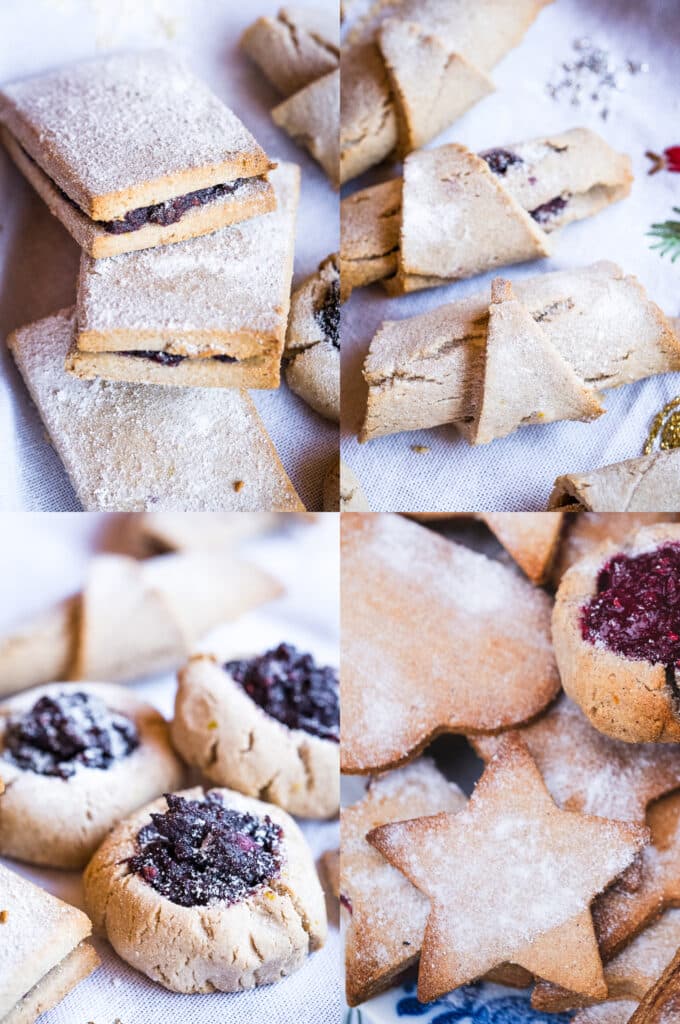
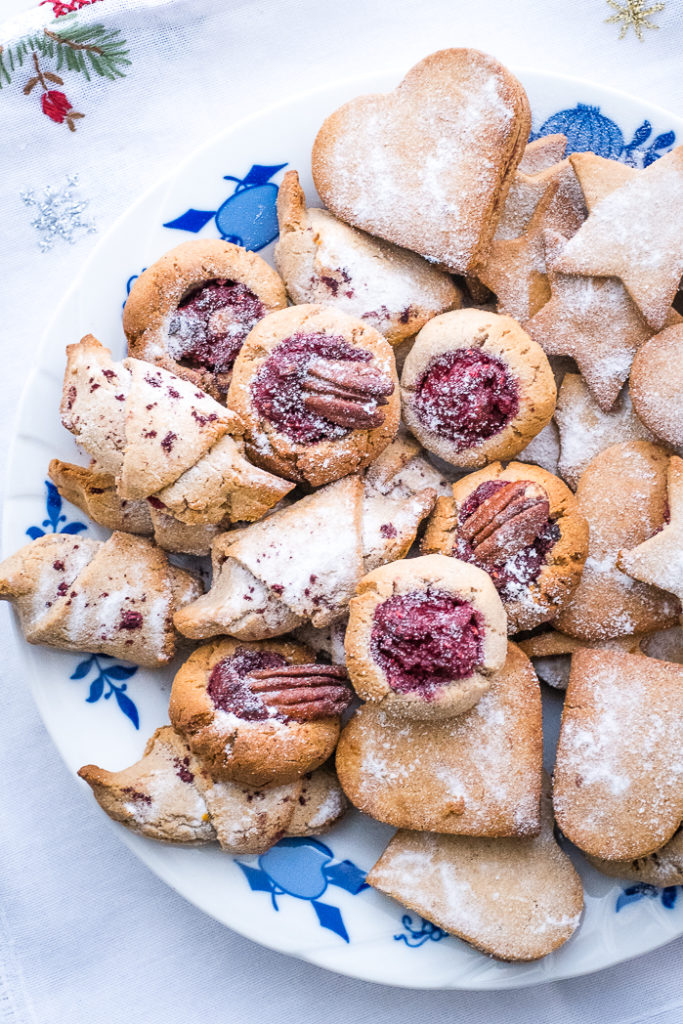
One simple gluten-free cookie dough, four different Christmas cookies. With a naturally sweet chestnut flour base and a homemade berry-and-nut filling, this versatile dough can be shaped into rugelach, Danish hindbærsnitter, thumbprint cookies, or classic cut-out cookies. They’re gluten-free, sugar-free, and festive enough for a Christmas cookie platter everyone can enjoy.
What I love most about this recipe is that you don’t have to make four different doughs to create a beautiful assortment of Christmas cookies. Make one batch, prepare one simple filling, and then divide the dough between whichever shapes you want to make.
The four variations also happen to reflect a little bit of our family story: Romanian-inspired rugelach for me, Danish hindbærsnitter for my husband, and classic thumbprint and cut-out cookies that work anywhere. You can make all four, choose just one or two, or use the dough to create your own Christmas cookies.
A Versatile Gluten-Free Christmas Cookie Dough
This dough is tender but sturdy enough to be rolled, cut, filled, and shaped in several different ways. Chestnut flour is particularly good here because it has a naturally sweet, slightly nutty flavor that feels perfect for Christmas baking and helps reduce the need for added sweeteners.
The dough comes together quickly in a food processor and needs only a short rest before shaping. Because we’re using the same dough and filling for all four cookies, you can create a varied Christmas cookie platter without making the process unnecessarily complicated.
An Overview of the Ingredients
The flour blend combines chestnut, almond, cassava, coconut, and tapioca flours, each contributing something slightly different to the final texture. Chestnut and almond flour provide flavor and richness, while cassava, coconut, and tapioca help create a dough that can be rolled and shaped.
Cold butter and egg give the dough structure and richness, while lemon zest and vanilla add a delicate aroma. I also like adding orange zest when I want an even more festive citrus flavor.
For sweetness, I use allulose, including a little extra for dusting the finished cookies (you can use a coffee grinder to turn any sweetener into a powder). If you use unsalted butter, add a pinch of salt to balance the flavors.
The simple filling is made from frozen berries and finely ground toasted walnuts or pecans. Blackberries, raspberries, and blueberries all work. The ground nuts aren’t just there for flavor: they absorb some of the berry moisture and turn the fruit into a thicker filling that stays inside the cookies more easily during baking.
How to Make the Dough
Combine the flours, then transfer them to a food processor. Add the inulin, egg, vanilla, citrus zest, and cold cubed butter and pulse until everything is incorporated.
At first, the mixture may look crumbly. Add the ice-cold water gradually, just until the dough begins to come together. You don’t want to add more water than necessary.

Shape the dough into a compact ball or disk, wrap it, and let it rest in a cool place for about 30 minutes. Keeping the dough cool makes it much easier to roll and shape, especially for the more delicate rugelach.
While the dough rests, preheat the oven to 340°F (170°C) and prepare the filling.
Make the Berry and Nut Filling
Gently warm the berries until softened, then blend or mash them into a thick purée. Mix in the finely ground toasted walnuts or pecans.
You are looking for a thick, spreadable consistency rather than a runny berry sauce. The nuts will absorb some of the liquid and help keep the filling in place as the cookies bake.
Now comes the fun part: turning one dough into four completely different Christmas cookies.
Romanian-Inspired Rugelach
These little crescents are inspired by the Romanian cornulețe cu gem și nucă I grew up with—small crescent-shaped cookies traditionally filled with jam and walnuts.
Roll half of the dough into approximately a 9-inch (23cm) circle and divide it into eight triangles, as you would cut a pizza. Keep any dough you aren’t working with in the refrigerator so it stays cool.
Place a small amount of berry-and-nut filling toward the wider end of each triangle. Don’t overfill them, as the filling will be harder to contain.
Starting from the wide end, gently roll each triangle toward the point to create a small crescent. This dough is more delicate than a conventional wheat dough, so handle it gently rather than trying to roll it too tightly.
Bake for approximately 12 to 15 minutes, or refrigerate the shaped rugelach while you prepare the remaining cookies and bake everything afterward.

Danish Hindbærsnitter
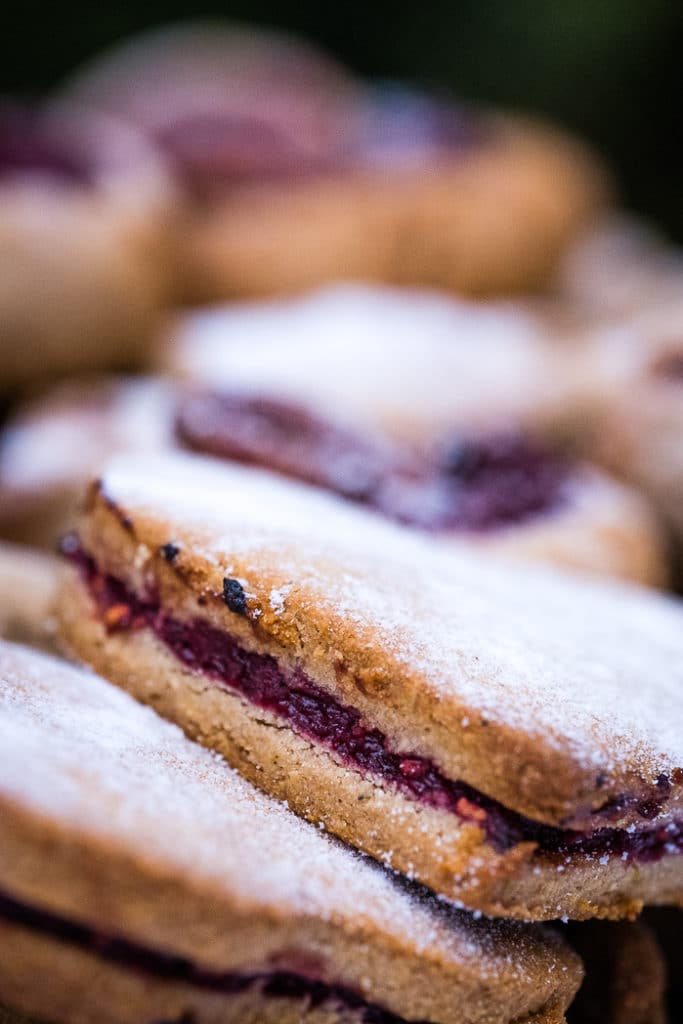
Hindbærsnitter are a classic Danish raspberry slice made from two layers of pastry with raspberry filling between them. Traditional versions usually have a sweet sugar glaze on top, but we will skip that.
Roll the dough into a rectangle and trim the edges to create an even shape. Cut it into equal pieces, making sure you have matching pairs.
Spread a thin layer of berry filling over half of the pieces, leaving a small border around the edges. Carefully place the remaining pieces on top to create cookie sandwiches.
You can keep them rectangular for a more traditional hindbærsnitter look or use cookie cutters to create festive shapes. Hearts are particularly pretty for the holidays.
Bake for approximately 20 minutes, or until the cookies are set and lightly golden around the edges.

Thumbprint Cookies
Thumbprint cookies are the easiest way to use the smaller pieces of dough left after trimming the other cookies, so don’t discard those edges.
Gather the scraps together gently and roll them into small balls. Make an indentation in the center of each one with your thumb or the back of a small measuring spoon, then add a little berry-and-nut filling.
Bake until the cookies are set and beginning to turn lightly golden.

Christmas Cut-Out Cookies
You can also keep things very simple and turn this dough into classic Christmas cut-out cookies.
Roll the dough into an even sheet and cut out any shapes you like. Stars, hearts, trees, or other simple shapes all work well.
Bake them plain, or make matching pairs and add berry filling between them to create little sandwich cookies similar to the hindbærsnitter.
This is also a good option if you want to dedicate the entire batch to one style of cookie rather than making all four variations.

Baking and Finishing the Cookies
As you shape each batch, place the cookies in the refrigerator. Keeping them chilled until they go into the oven helps the dough maintain its shape during baking.
Because the size and thickness vary between the four styles, the baking time will vary slightly as well. The smaller rugelach will be ready sooner, while larger sandwich cookies will need more time. Look for cookies that are set and just beginning to develop a little color around the edges.
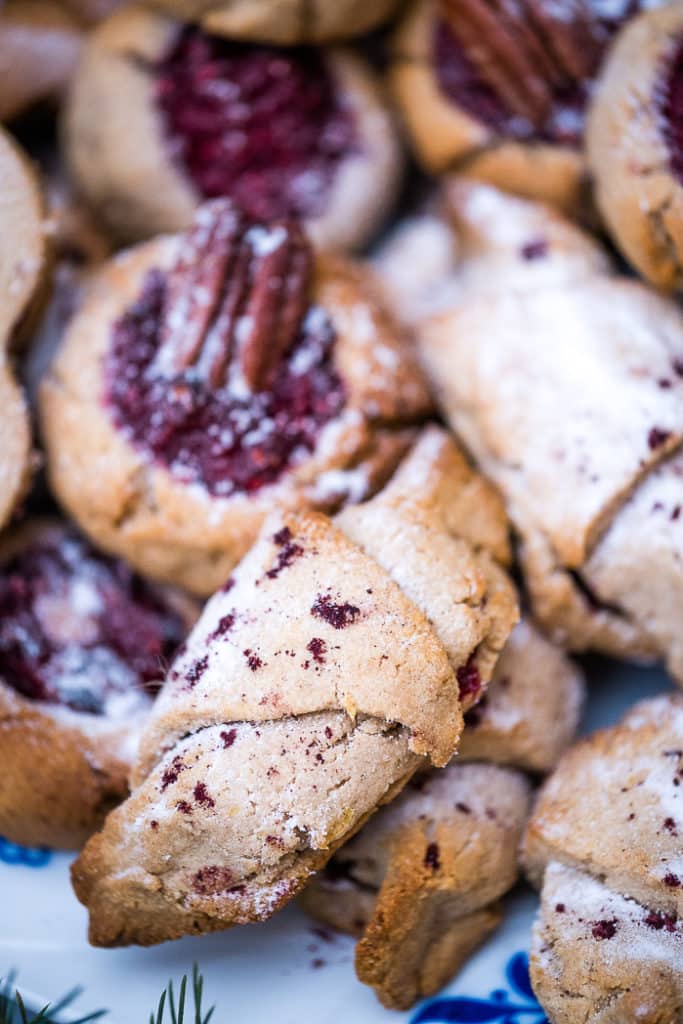
Once cooled, dust them lightly with inulin powder or your preferred powdered sugar-free sweetener for that classic snowy Christmas-cookie finish.
How to Store Gluten-Free Christmas Cookies
Store the baked cookies in a covered container in the refrigerator for two to three days.
They can also be made ahead and frozen, which makes this recipe particularly convenient for Christmas. Prepare a batch when you have time, freeze the baked cookies, and you’ll have a homemade gluten-free and sugar-free cookie assortment ready for the holidays.
Whether you make all four versions or choose just your favorite, this simple dough is an easy way to bring variety to a Christmas cookie platter without making four separate recipes.
More gluten-free cookie recipes
I hope you love these lectin-free, sugar-free, and gluten-free Christmas cookies.
For another healthy Christmas butter cookie recipe, check out our Lectin-Free Christmas Cookies with Orange and Raspberries.
For more gluten-free cookie recipes, check out these:
- Gluten-Free Shortbread Cookies — Tender, Crisp, and Sugar-Free
- Millet Flakes Chocolate Chip Cookies
- Gluten-Free Almond Thumbprint Cookies
- Tigernut Flour Cookies with Rosemary and Olive Oil (Sugar-Free, Gluten-Free)
- Gluten-Free Spritz Cookies (Sugar-Free)
- Gluten-Free Almond Biscotti Recipe (Low-Carb, Sugar-Free)
*This post contains affiliated links, which means I get a small commission if you choose to purchase something via one of my links, at no extra cost to you.
Print
Gluten-Free Christmas Cookies: One Dough, Four Ways
- Prep Time: 1 hour
- Cook Time: 15 minutes (up to 20 minutes)
- Total Time: 1 hour 15 minutes
- Yield: 14 cookies (different shapes)
- Category: Dessert, Snack
- Method: Baking
- Cuisine: European
- Diet: Gluten-Free
Description
One simple gluten-free cookie dough, four different Christmas cookies. With a naturally sweet chestnut flour base and a homemade berry-and-nut filling, this versatile dough can be shaped into rugelach, Danish hindbærsnitter, thumbprint cookies, or classic cut-out cookies. They’re gluten-free, sugar-free, and festive enough for a Christmas cookie platter everyone can enjoy.
Ingredients
For the dough
- 75g chestnut flour
- 50g almond flour
- 40g cassava flour
- 20g coconut flour
- 20g tapioca flour
- 1 tablespoon allulose
- 100g cold butter, cubed (I use French or Italian A2 butter)
- 1 pastured egg
- Zest of 1 organic lemon
- Zest of 1 organic orange, optional
- 1 teaspoon vanilla extract
- Pinch of salt, if using unsalted butter
- 2–3 tablespoons ice-cold water, as needed
- Inulin powder or another powdered sugar-free sweetener, for dusting
For the berry and nut filling
- 1/2 cup fresh or frozen berries, such as blackberries, raspberries, or blueberries
- 1/4 cup finely ground toasted walnuts or pecans
Instructions
- Prepare the dough. Combine the chestnut, almond, cassava, coconut, and tapioca flours. Transfer to a food processor and add the sweetener, cold butter, egg, citrus zest, vanilla, and salt, if using. Pulse until combined. Add the ice-cold water gradually, just until the dough comes together.
- Rest the dough. Shape the dough into a disk, wrap it, and let it rest in a cool place for about 30 minutes. Meanwhile, preheat the oven to 340°F (170°C) and line a baking sheet with parchment paper.
- Make the filling. Gently warm the berries until soft, then blend or mash them into a thick purée. Stir in the ground toasted walnuts or pecans. The filling should be thick and spreadable rather than runny.
- For rugelach: Roll half of the dough into a 9-inch (23cm) circle and cut it into 8 triangles. Add a small amount of filling near the wide end of each triangle, then gently roll toward the point to form a crescent. Bake for 12–15 minutes, or until set and lightly golden around the edges.
- For hindbærsnitter: Roll the dough into a rectangle, trim the edges, and cut it into an even number of equal pieces. Spread a thin layer of filling over half of the pieces and cover with the remaining pieces to make sandwiches. Alternatively, use matching cookie-cutter shapes. Bake for about 20 minutes, or until set and lightly golden.
- For thumbprint cookies: Gather leftover pieces of dough and gently roll them into small balls. Make an indentation in the center of each cookie and fill with a small amount of the berry mixture. Bake until set and lightly golden.
- For cut-out cookies: Roll the dough into an even sheet and cut into your favorite Christmas shapes. Bake them plain or make matching pairs and use the berry mixture to create sandwich cookies. Bake until set and lightly golden.
- Finish. You can refrigerate the shaped cookies while preparing the remaining variations and bake them when ready. Allow the baked cookies to cool, then dust with inulin powder or your preferred powdered sugar-free sweetener.
Notes
Keep the dough cool while working with it, especially when making the rugelach. If it becomes too soft or difficult to handle, refrigerate it briefly before continuing.
For more sweetness, feel free to add extra sweetener to the dough. You can also add a little bit of allulose to the berry and walnut filling.
Store the cookies in a covered container in the refrigerator for 2–3 days. The baked cookies can also be frozen for longer storage.
14 Comments
Debra
April 23, 2026 at 12:18 pmwhat can I use instead of the butter ( I am also dairy free) and the plastic wrap? Thank you!
Claudia
April 24, 2026 at 3:47 amHi Debra! These are butter cookies so I don’t think there is a replacement for butter, other than vegan butter, which I never work with and have no idea how it works with cookies. Why don’t you try to find a recipe that is created to be dairy-free? When we create recipes, especially desserts / baked stuff, we have an intention from the start – this was to make butter cookies, and we build around that. When I want to create something with the intention of being dairy free, is a totally different process and frame, especially for things like cookies. Unless you want to go ahead and try vegan butter, I don’t have another suggestion for this specific recipe. xx -Claudia
Linda
December 7, 2023 at 12:20 amHi Claudia can the chestnut flour maybe be replaced with tiger nut flour?
Claudia
December 7, 2023 at 2:25 amHi Linda! From a taste perspective, yes, as tigernut is also a sweet flour. From a texture perspective, tigernut tends to be slightly gritty, as opposed to chestnut which is a very fine flour. So they’ll probably come out, and I personally wouldn’t mind the gritty texture as I’m used to it, but I can’t speak for anyone else. I would rather replace it with cassava flour, but you have to make up for the taste loss, as cassava is bland (while chestnut flour is very sweet and nutty). I hope this helps! -Claudia