Description
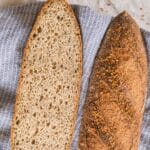
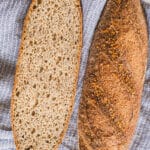
These gluten-free sourdough baguettes are a rustic, wholesome take on a classic, made with a blend of sorghum, millet, and teff flours, plus nutrient-dense hemp flour for added protein and fiber. Using a simple demi-baguette technique, the dough is shaped into two baguettes with ease, making this recipe especially approachable for gluten-free baking. The result is a crusty, golden exterior and a light, airy crumb — slightly darker in color, richer in flavor, and perfect for everyday slicing, toasting, or serving alongside a nourishing meal.
Ingredients
PREFERMENT
- 10 g active gluten-free sourdough starter
- 33 g water
- 35 g flour mix (equal parts sorghum, millet, and teff)
WET MIX (PSYLLIUM GEL)
- 17 g psyllium husk flakes
- 420 g water (400 + 20)
- 10 g honey
- 8 g extra virgin olive oil
- 75 g sorghum, millet & teff preferment
DRY MIX
- 200 g flour (75 g sorghum flour + 75 g millet flour + 50 g teff flour)
- 30 g whole hemp flour
- 70 g tapioca starch
- 6 g salt
EXTRA
- hemp seeds for topping
Instructions
- Preferment — The evening before baking (or 6–8 hours before mixing the dough, in case you prefer to make it in the morning), mix all preferment ingredients in a small jar. Cover and leave at room temperature overnight (or the 6-8 hours needed to get to peak activity).
- Psyllium gel (the wet mix) — When the preferment is ready, in a large glass or plastic bowl, combine 400 g water, psyllium husk flakes, honey, and olive oil. Mix well and set aside for about 5 minutes, until a thick gel forms.
- Mixing the dough — In a separate bowl, thoroughly mix all dry ingredients. Add the preferment to the psyllium gel (to make sure you use all the preferment, clean the jar using the remaining 20 g water) and stir to combine, then transfer this mixture to the bowl with the dry ingredients. Mix first with a spatula or wooden spoon, then use your hands to fully incorporate the dough until homogeneous, soft, and sticky, with no visible lumps.
- Kneading — Using a silicone or plastic dough scraper, scrape the dough from the sides of the bowl and fold it toward the center. Rotate the bowl and repeat this motion about 20 times. Cover the bowl and keep it at room temperature to begin fermentation.
- Bulk fermentation — Let the dough ferment for 1–2 hours, depending on ambient temperature. For a temperature around 22 °C / 72 °F, ferment for about 1 hour 10 minutes. Increase if colder, reduce if warmer. The dough should appear slightly puffed and jiggly.
- First shaping — Lightly dust a work surface with flour. Gently invert the dough onto the surface. Lift one-third of the dough from the side furthest from you and fold it over itself toward you, then fold once more so the underside becomes the top. Gently but firmly shape the dough into a log and seal the bottom by moving it gently from side to side to create a slight tension with the surface.
- Proofing — Dust a 10-inch oval banneton lined with a towel and dusted with flour. Transfer the dough with the sealed side facing up and the smooth side down. Lightly dust the surface with flour and cover with the towel and another towel or plastic cap. Proof at room temperature for approximately the same length of time as the bulk fermentation.
- Oven preparation — Forty-five minutes before baking, preheat the oven to 250 °C / 480 °F, with a heavy duty stainless steel baking tray inside, on the middle rack. Below, place a smaller tray with a few cups of cold water (the water should be steaming once the bread gets into the oven).
- Shaping the baguettes — Gently invert the proofed dough onto a sheet of parchment paper. Lightly dust the surface with flour and gently spread the flour with your palm. Using a piece of kitchen twine as a guide, mark the center line lengthwise, then divide the dough into two equal pieces with a plastic scraper. Turn each piece so the cut side faces up. Starting along the cut edge, gently pinch the dough together with your fingers to seal it. Lightly dust with flour, then place each piece seam-side down on the parchment. Repeat with the second piece. To finish shaping, gently elongate each baguette and lightly pinch the ends to create pointed tips.
- Topping — Spray the surface lightly with water using a spray bottle, then sprinkle the hemp seeds on top and distribute them on top of the dough. Lightly dust with flour.
- Scoring — Score using a razor or scoring blade, firmly cut 4 oblique lines on top of each baguette (about 1/2 cm deep).
- Baking with steam — Carefully remove the hot baking tray from the oven (handle with gloves). Slide the dough onto the hot tray, using the parchment paper. Return to the oven, and bake for 10 minutes, then reduce the temperature to 235 °C / 455 °F and bake for 10 more minutes (20 minutes in total with steam).
- Finish baking (no steam) — Remove the water tray from the oven, and continue baking for about 30 minutes, until the crust hardens and the bottom of the bread sounds hollow.
- Cooling — Remove the bread from the oven and cool on a wire rack for at least 3 hours before slicing.
- Storage — Store at room temperature for 2–3 days in a paper bag or wrapped in a cotton towel. For longer storage, slice the loaf into small, regular slices or lengthwise halves, separate with parchment paper, and freeze. Thaw at room temperature and toast or reheat directly in the toaster or oven.
Notes
Best serving experience: the bread will slightly stiffen on the second and third day, but it will regain moisture and softness once gently toasted in a toaster or an oven.